
Believe them, and recognize them anyway in a different form. The instinct to read “please don’t make a fuss” as modesty to be overridden is the most common mistake here. There is a documented psychological construct behind the discomfort, and the underlying cause is usually not shyness or false humility. It is a rational concern about being repositioned against colleagues, or about the expectations that follow praise.
The good news is that what most people in this position object to is the spotlight, not the appreciation. Those are separable.
Why do people genuinely dread being praised?
Psychologists have a name for this. Fear of Positive Evaluation, or FPE, was first proposed by Weeks, Heimberg and Rodebaugh in 2008 and has been studied consistently since. The mechanism has an obvious workplace reading. Standing out among colleagues raises the stakes of a misstep and can invite competitive pressure, and praise itself raises the expectations you will be held to afterwards. It is a rational calculation, not modesty or shyness.
For the fuller research on the mechanism, the population it has been studied in, and why most employees still prefer public recognition, see Do Employees Prefer Public or Private Recognition?.
Population caveat: this research has been conducted largely in socially anxious samples. It establishes that the discomfort is real and mechanistically explained. It does not tell you what proportion of any given team experiences it, and most employees do prefer public recognition. This article is about the minority who do not.
Is it shyness, or something else?
Three misreadings are common enough to name.
“They’re being modest.” Sometimes. But the research points at concerns that are strategically rational rather than performative, and treating a real concern as false modesty means overriding it.
“They’re an introvert.” Introversion and spotlight aversion overlap without being the same thing. Plenty of introverts are happy to be recognized publicly provided they do not have to perform a reaction in real time. The useful question is not whether someone likes attention. It is whether they like being watched while reacting.
“They don’t want recognition.” Almost never true. Research on recognition preferences finds that even most people who say they prefer private recognition want a smaller audience rather than no audience.
Does the same thing apply to office birthdays?
Partly, but a birthday at work adds a second, completely different reason. Some employees do not want to celebrate their birthday at all for religious reasons, most visibly Jehovah’s Witnesses, and that is not spotlight aversion.
The two need different handling. Someone with FPE still wants to be appreciated, just without the performance of it. Someone who does not celebrate their birthday for religious reasons usually wants no acknowledgment of the date at all, not a quieter birthday party. Ask which situation you are dealing with rather than assuming, so a genuine religious position does not get mistaken for shyness.
There is a real policy dimension here too. Insisting on a birthday celebration after an employee has said they do not want one can read as making a big deal out of a protected belief, not just an awkward moment. The safer default for teams that run birthday parties, whether that is cake, decorations, or a shared birthday list in the break room, is opt-in. Ask new hires early whether they want a birthday celebration at all, and treat a no as final without follow-up questions.

How do you separate the audience from the spotlight?
This is the practical move, and it resolves most cases.
Public and private are not one variable. Recognition has at least two independent dimensions:
- Audience. How many people know about it.
- Spotlight. Whether the person has to react in real time while being watched.
An all-hands callout is high on both. A manager praising someone at their desk in front of two colleagues is low audience but high spotlight, and is often worse than a stage, because there is no ceremony to hide inside. Something written, signed by many colleagues, and read alone at a desk is high audience with no spotlight at all.
That last category is what most spotlight-averse people are comfortable with, and it is the one the public-versus-private framing has no vocabulary for. They are not asking for secrecy. They are asking not to perform.
Would you like to send appreciation as a group instead, without asking anyone to perform gratitude in front of a room? Try an employee appreciation card that everyone adds their note to online, and the person reads in their own time.
What should you do instead of a public moment?
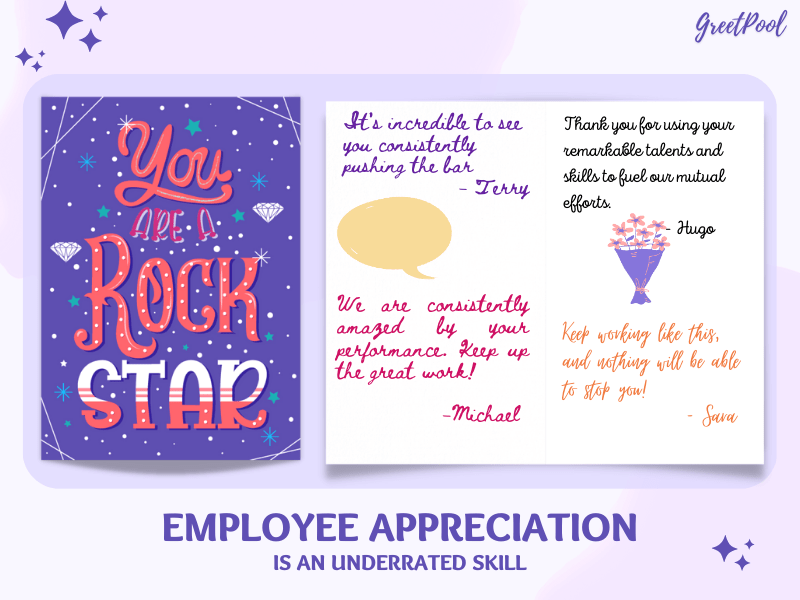
- Written recognition from colleagues. Wide audience, no live reaction required, and the person controls when they read it. A coworker appreciation card is built for exactly this. Colleagues sign through a shared link, no account needed, and as many people as want to can add a note. The finished card comes out as a printable PDF, so the person opens it on their own, at their own desk, whenever they choose to. Group cards are what we build at GreetPool, so read that as a disclosed interest.
- Tell their peers, not the room. Recognition that circulates among the people whose opinion the person actually values, without a formal moment.
- Put it in writing where it counts. A note to their manager’s manager, or in a performance record, carries real career weight and requires no reaction at all.
- Recognize the work rather than the person. “This project went well because of the way the migration was handled” delivers the same information without the ranking.
- Give something instead of saying something. Time back, a better project, a choice about their next piece of work, or an employee gift card if the budget allows. These carry recognition without an audience.
- Ask, then follow it. The most reliable option and the least used.
None of this requires a program. If your team’s usual playbook for recognition leans on ranking people against each other, see does Employee of the Month actually work for why the competitive format tends to backfire for a related reason.
What should you avoid?
- Overriding a stated preference “because they deserve it.” The person told you. Doing it anyway communicates that their comfort was less important than your intention.
- Announcing that someone dislikes attention. Saying “I know she hates this, but…” creates the exact moment you were trying to spare them, with an audience now primed to watch their reaction.
- A surprise. Surprise removes their ability to prepare, which is precisely what the discomfort is about.
- Repeatedly testing it. Trying again next quarter to see if they have changed reads as not having listened.
- Excluding them from recognition entirely. The opposite failure, and a real one, covered in what happens when someone is left out of a team celebration. Quietly dropping someone from all recognition because it is awkward is not respect, it is exclusion with a justification.
How do you find out without making it awkward?
Ask during onboarding, along with the other logistics questions. When you have done something well, would you rather it was mentioned in front of the team or told to you directly? At that point in someone’s tenure it reads as ordinary. Later it does not.
Otherwise, watch what happens after. Deflection, subject changes, or going quiet in a channel are reliable signals. People rarely say stop, but they show you.
And if something significant is coming, ask directly: “I’d like to mention this at the all-hands, are you comfortable with that?” Thirty seconds, and it removes the whole risk.
Whoever asks that onboarding question is often also the person who ends up running the celebration itself. If that has not been decided deliberately on your team, see who should organize team celebrations at work.


← More message ideas. Browse what to write for every occasion, by recipient and tone.
Research cited
- Weeks, J. W., Heimberg, R. G., & Rodebaugh, T. L. (2008). The Fear of Positive Evaluation Scale: Assessing a proposed cognitive component of social anxiety. Journal of Anxiety Disorders, 22(1), 44–55.
- Reichenberger, J., & Blechert, J. (2018). Malaise with praise: A narrative review of ten years of research on the concept of fear of positive evaluation in social anxiety. Depression and Anxiety, 35(12), 1228–1238.
- Wallace, S. T., & Alden, L. E. (1995). Social anxiety and standard setting following social success or failure. Cognitive Therapy and Research, 19, 613–631.
Frequently asked questions
Why do some employees hate being praised in public?
Usually it isn't shyness. Research on Fear of Positive Evaluation describes a rational calculation: standing out among colleagues invites competitive pressure, and praise raises the bar you're held to next. Believe the discomfort rather than reading it as false modesty.
Should you still recognize someone who says they don't want it?
Yes, in a different form. What most people in this position object to is the public moment, not the appreciation. Written recognition from colleagues, a note on their record, or telling their peers all deliver recognition without a spotlight.
How do you ask colleagues not to celebrate your birthday?
Say it plainly and early, ideally before the date arrives, rather than deflecting in the moment. Something like I don't want to celebrate my birthday this year, but thanks for thinking of it works, and it is reasonable to expect the request to be honored without being asked to explain why.
Is it rude to skip someone's birthday if they asked you to?
No, if they asked. It is worth confirming that they want it skipped entirely rather than kept low-key, because those are different requests and people often mean the second.
Is it appropriate for a manager to publicise employees' birthdays?
Only with the employee's knowledge. A shared team calendar or automated happy birthday announcement assumes consent that was never asked for. Ask once, during onboarding, and let the answer decide it rather than defaulting to publishing everyone's date.
How do you recognize someone without making it a big deal?
Choose formats with a wide audience and no live reaction moment: something written, from colleagues, that the person reads on their own time. It delivers the social visibility without the performance.